Viable System
The Viable System Model – Part 5
The same five-function pattern that makes a company viable also makes a team viable, and a division, and the whole industry it sits inside. Part 5: recursion — why a viable system is viable all the way down, and what that means for where you point the model.
Every viable system contains viable systems and is contained in a viable system.
Stafford Beer
Recursion — the pattern inside the pattern
Through the first four parts, we drew a single organization: five systems, one environment, one process, one identity. It is tempting to stop there, satisfied, with the whole model finally on the page. But we have only drawn one floor of a building that goes up and down forever.
Look again at System 1. We have been treating each operational unit as a box — a doer that performs an operation and reports up. That is a convenient lie. Open any one of those boxes and you do not find a simple component. You find another complete organization: a unit with its own operations, its own coordination, its own internal eye watching itself, its own sense of what is coming, and its own identity. Each System 1 is, in full, its own Viable System.
This is the recursion, and it is the most elegant thing in the whole model. The five-function pattern does not describe one level of an organization. It describes every level, repeating, like the same shape appearing whether you look at a coastline from orbit or from the sand.
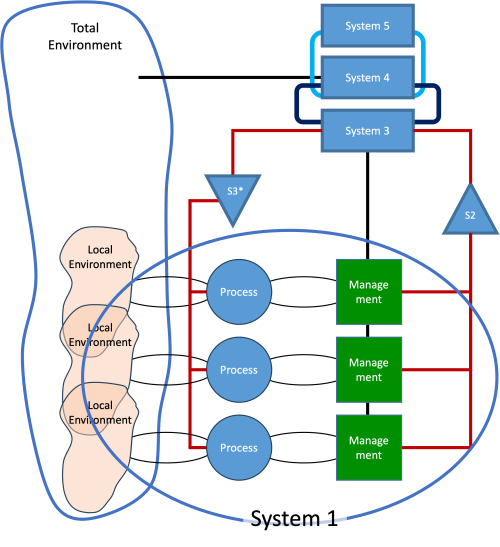
The body shows it plainly. A cell is a viable system — it senses, regulates, optimizes, anticipates, and holds an identity. An organ made of those cells is itself a viable system. The body made of those organs is viable. And the body lives inside a social system that is viable in turn. Cell within organ within body within society — at every scale, the same five functions, each whole system nested inside a larger one and built from smaller ones.
Organizations are no different. A single team is a viable system: it operates, coordinates its members, monitors itself, scans its corner of the world, and knows what it is for. That team sits inside a department, itself viable. The department sits inside a division, the division inside the company, the company inside its industry and market — and the pattern holds, unbroken, all the way up and all the way down.
Two consequences fall out of this, and both are practical.
The first is that you can point the model at any level. The diagnosis — does this system have all five functions, and are they in balance? — works on a two-person team and on a multinational, because they are the same kind of thing at different scales. When something is wrong, you do not need a different theory for each altitude. You need to find the level where a function has gone missing or seized up.
The second is that viability is not granted from the top. A company is not viable simply because its executive team is sharp. It is viable only if it is viable all the way down — if each nested system, at each level, holds its own five functions. A brilliant System 5 at the top cannot save an organization whose teams have no internal coordination, no eye on their own work, no identity of their own. The rot, or the health, runs through every layer.
This is also where a great deal of management goes wrong: confusing the levels. A leader reaches down past two layers of recursion to direct a single operational unit, and in doing so strips that unit of the autonomy — the requisite variety — it needs to manage its own environment. The recursive view keeps you honest about altitude. It tells you to grant each level its own viability, intervene only at the level where the problem actually lives, and resist the urge to run a system three floors down as if it had no inside of its own.
So the Viable System Model is not a chart of one organization. It is a single pattern that holds at every scale at once — each viable system whole in itself, containing whole systems, contained by them. Learn to see it on one floor, and you have learned to see it on all of them.