Viable System
The Viable System Model – Part 1
Why design a viable organization from scratch when the most road-tested viable system on Earth has been walking around for millions of years — us? Part 1: the human body, the brain, and the foundation Stafford Beer built from them.
Every year, companies spend a fortune trying to design themselves: reorganizing, redrawing the boxes, hiring someone to tell them what a healthy structure looks like. And the whole time, the most thoroughly tested viable system on the planet is sitting in the room — it is the people doing the reorganizing.
Human beings have survived and adapted through millions of years of a harsh, shifting environment. That is viability, demonstrated at a scale no company can claim. So instead of reinventing the wheel, Stafford Beer asked a better question: what can we learn by studying how the body governs itself? How does the brain control and coordinate the body while it deals, moment to moment, with a world that is constantly trying to knock it over?
Science has sought the ultimate source of energy in the physics of the sun itself … the hydrogen-helium fusion. Science now seeks the ultimate source of control, in the cybernetics of natural processes … the brain itself.
Cybernetics and Management, Stafford Beer, 1959
That study of the brain is the seed of the Viable System Model. From it, Beer identified five interrelated systems that govern the human body — and, he argued, any viable organization:
- System 1 — the organs and the doers: the parts that actually perform an operation.
- System 2 — the sympathetic nervous system: holding the body’s homeostasis steady and keeping the organs from working against each other.
- System 3 — the base brain: overseeing the muscles and organs, optimizing the internal operation as a whole.
- System 4 — the mid-brain: the link to the outside world through the senses, responsible for anticipating, projecting, and planning ahead.
- System 5 — the higher brain: the identity. Who this person is.
Hold onto those five. The rest of this series is really just the slow unfolding of what each one does, and why an organization missing any of them starts to wobble.
The development of the model
Three questions drive the whole project:
- Can we build one model that describes an organization regardless of what it does?
- Can we name the underlying principles behind how any organization actually behaves?
- And what does an organization need in order to stay viable?
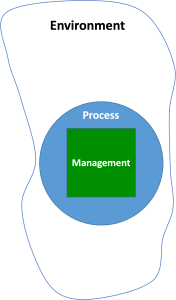
Start with the simplest possible picture. Every organization exists to manage some process inside some environment. A bank manages the process of delivering financial services to its clients. A hospital manages the delivery of care to the community around it. Strip away the specifics and three elements are always there:
- an environment,
- in which a process happens,
- for which management is in place.
Complexity and variety
The environment and the process are easy enough to see. The harder question is the one we skip: what is management actually for?
In the traditional answer, management exists to handle money, people, materials, equipment. But we are after something more basic — a single thing that is the same in every act of managing, whatever the industry. Here it is: if there were only one way to do something, management would have nothing to do. You manage precisely because there are choices. The more options the situation throws up, the more there is to decide, weigh, and coordinate. The job of management, underneath all its forms, is to deal with complexity.
The more complex a situation gets, the harder it is to manage, and the bigger becomes the organization around it.
Stafford Beer
And if we are going to manage complexity, we need a way to measure it. In cybernetics, that measure is variety: the number of distinct states a system can be in. The more complex a system, the more variety it has, and the other way around. Which leads straight to the idea the whole model turns on:
Requisite Variety
To manage a process with a certain amount of variety, the management function needs at least that same amount of variety.Stafford Beer
This is Requisite Variety, first stated by W. Ross Ashby, and it does a lot of quiet work in everything that follows.
Picture controlling the temperature of your room. In the dead of winter, if the room has only two states that matter to you — comfortable and not — then a thermostat with a variety of two will do: warm air on, warm air off. Two states in the world, two states in the controller. Balanced.
Now get energy-conscious. You want the heat to drop while you are out and rise before you get home. Suddenly the situation has more than two states — asleep, morning, away, almost home, home — and a simple on/off switch can no longer match it. You need a controller with enough variety to answer each of those states. Split weekdays from weekends and you have added more variety still, and your thermostat has to grow to meet it. The controller must carry as much variety as the thing it controls. Always.
Variety in the model
Go back to the management–process–environment picture, and one thing is obvious: the environment holds vastly more variety than the process, and the process holds far more than any management team could ever track.
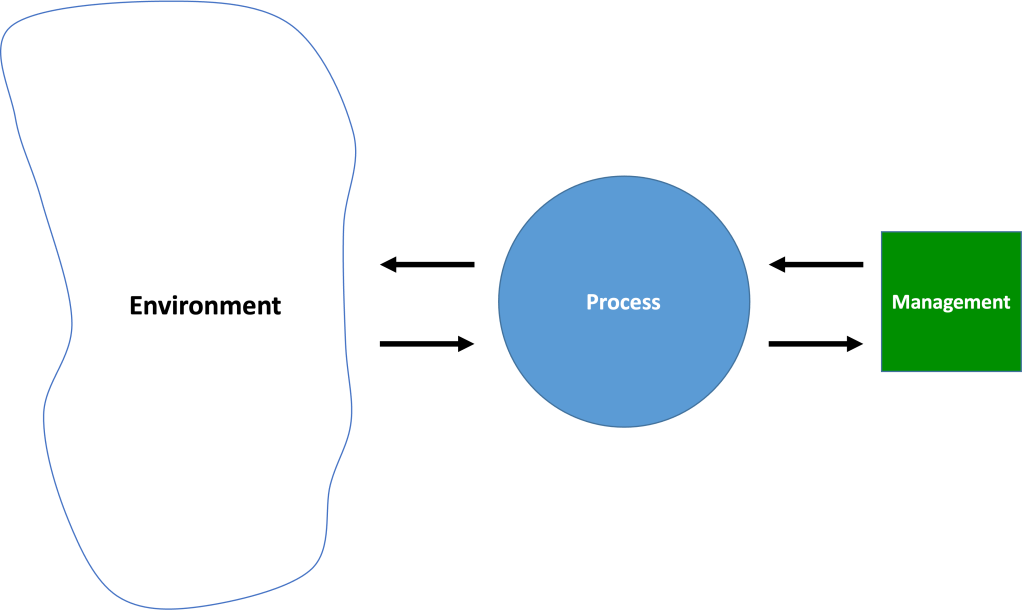
Take a manufacturing company. Its environment teems with variety — competitors, regulators, suppliers, customers, creditors, all moving at once. Its internal processes are nearly as wild — production, material handling, quality control, the friction between people, training, maintenance. Both dwarf the handful of states a single manager can actually hold in mind. So here is the first real design problem: how can management possibly handle that much variety, inside the organization and out?
The answer is almost suspiciously simple. You change the variety on both sides until they meet. Where management has less variety than the process, it must amplify its own — and at the same time attenuate, or cut down, the flood of variety coming back at it from the process.
Attenuation is the dashboard: instead of drowning the leadership team in raw data, you hand them a clean, summarized view that keeps only what changes a decision.

The same dance plays out between the process and the environment. The process amplifies its variety outward — say, through marketing — and attenuates the environment’s overwhelming variety inward, through things like market research and segmentation.
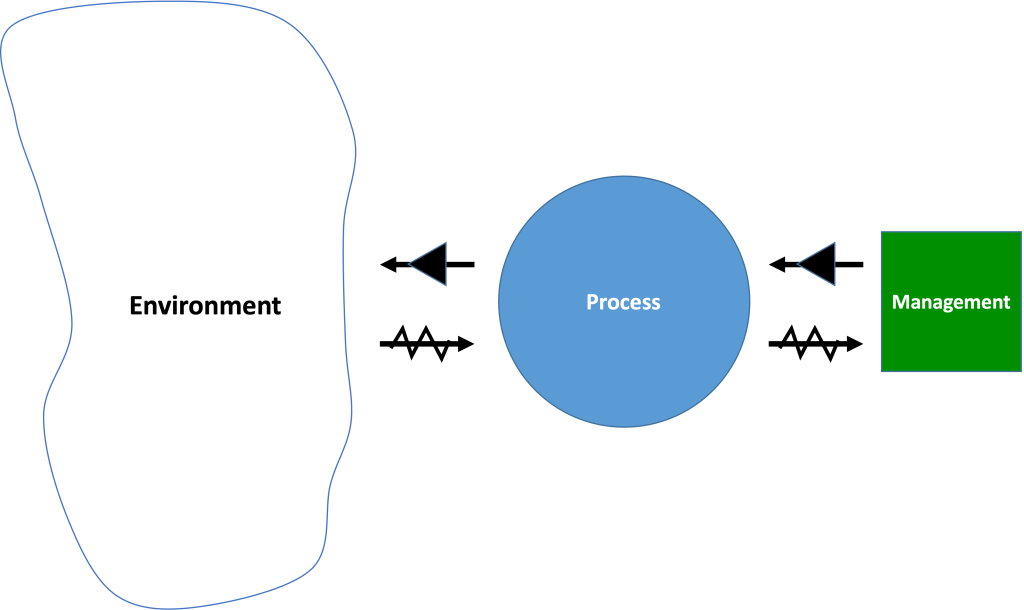
Once you see it, you cannot unsee it: nearly every management technique ever invented is just some combination of amplifying and attenuating variety between management, process, and environment.
- Optimization
- Team-based management
- Learning organizations
- Total quality management
- Market research
- Process reengineering
- Management by objectives
They are all moves in the same game. In Part 2, we start adding the systems that keep those moves from tearing the organization apart.