Viable System
The Viable System Model – Part 3
A senior manager is not a point of authority — they're a service provider. That sounds soft until you see the variety math behind it. Part 3: why autonomy is structural, and how System 3 generates synergy without crushing the parts that make it.
If cybernetics is the science of control, management is the profession of control.
Stafford Beer
Authority, or service?
A Viable System is not a hierarchy, and it is not run by authority. In Beer’s design, a senior manager is a service provider, not a point of command — and the reason is not philosophy. It is the law of variety.
You simply cannot have an operational unit that copes, in real time, with the enormous variety of its environment and waits to be told what to do at every step. The two demands contradict each other. The variety the unit faces is too large to route through a boss.
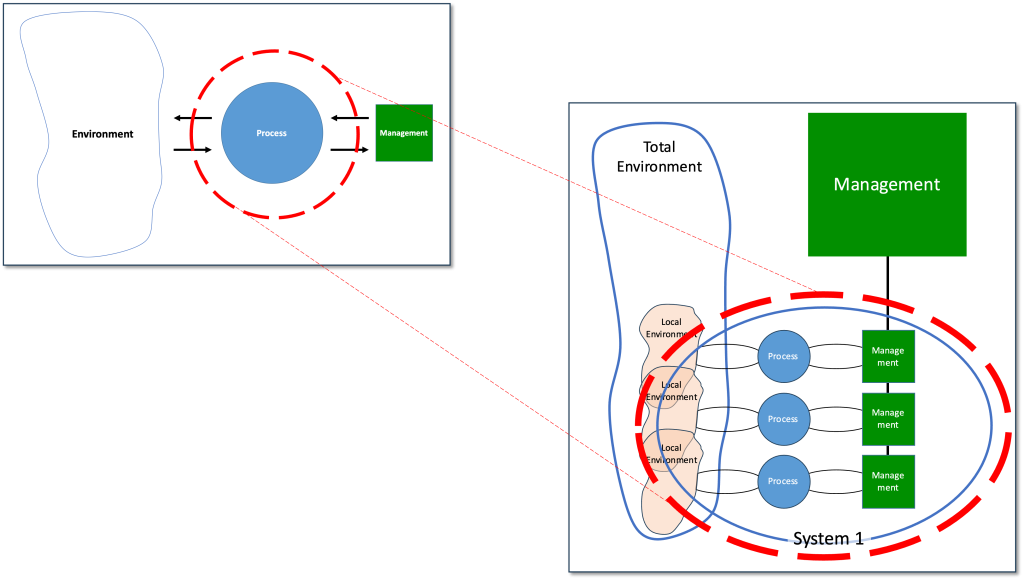
So System 1 sub-systems are designed for the maximum autonomy possible. The only thing that bounds that autonomy is purpose: each unit’s purpose has to stay aligned with the purpose of the whole. Free to act, anchored to a shared direction. With that established, let’s look more closely at the rest of the design.
System 2 — coordination and conflict management
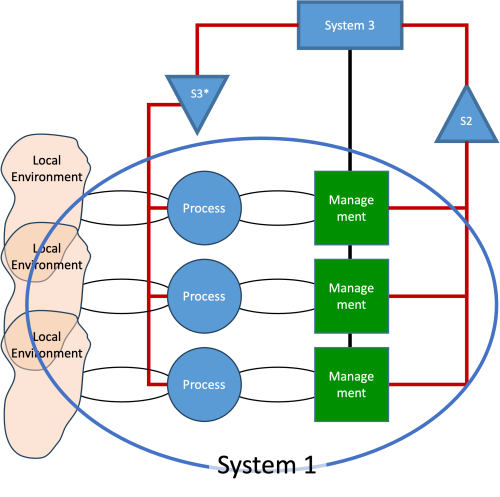
We said System 2 exists to hold cohesion between processes.
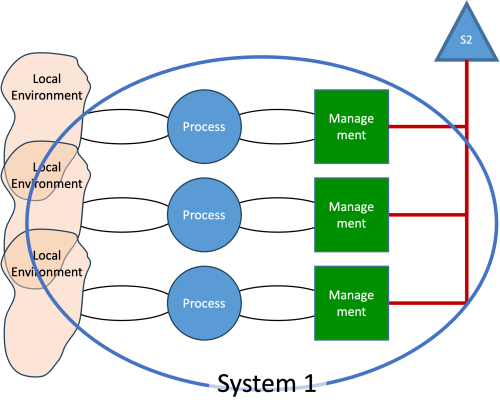
Without it, each horizontal management chases its own maximum, blind to the fact that it sits inside a larger system where every part touches every other. Maximize one part and you can quietly cripple another.
This is not a flaw to be scolded away. Different parts of an organization have different purposes, so they will, by definition, want different things.
Conflict: a discomforting difference.
Embrace Happiness – The Art of Conflict Management, Ali Soleymaniha, 2014
Left unchecked, those conflicting interests breed instability and disharmony, and disharmony, given enough time, takes the whole system down. Back to the manufacturer: drive inventory to the floor to please finance, and sales can no longer serve customers on time; sales pushes inventory back up, and the financial metrics suffer. The system oscillates, swinging between two unhappy extremes, never resting. System 2 is what damps that swing.
And it does so without force. Its nature is the service provider’s, not the overseer’s — the kind of “control” that has nothing to do with the word’s usual hard edge. Think of a shared vacation timetable for a project team. The timetable does not dictate when anyone may take a holiday. It simply offers a service, so people can coordinate their time off and the project always stays covered. That is the whole spirit of System 2.
Here is the danger, though, and it is the one most organizations fall into. System 2 has an unhealthy urge to become a Viable System in its own right — to reach for more and more control until it has grown into a sprawling bureaucracy. The art is to find the equilibrium between “no coordination” and “over-control,” and missing that balance is one of the great quiet causes of organizational failure.
So hold System 2 in its proper role: a service provider for coordination, shared information, common standards, and shared values — the organization’s repository of how-we-do-things, not its police force.
System 3 — the internal eye
We now have environments, processes, managements, and a function to hold cohesion and stop oscillation. Is that enough? What are we still missing?
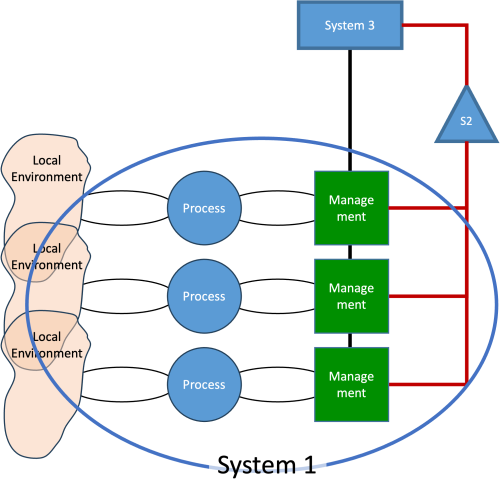
System 2 lets the organization absorb some of the conflict between System 1 units. But every one of those horizontal units is fully consumed by managing its own process and its own slice of environment. Nobody is yet standing back to watch the whole and ask whether it is, in aggregate, working well.
That is System 3. It observes the state of all the sub-systems at once and keeps their combined effort tuned toward the overall goal. It is an internal eye — responsible for operations planning, and for the close, immediate monitoring of how the organization is actually running.
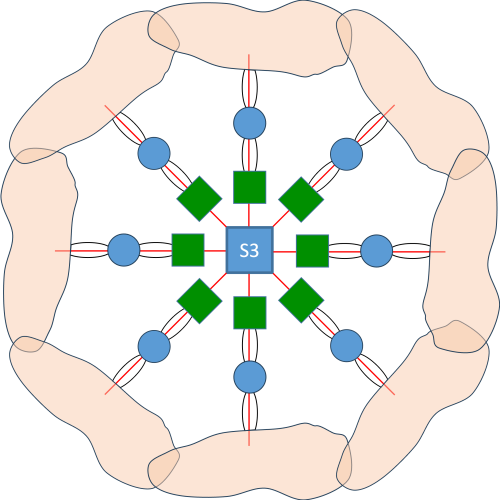
Think of System 3 as the vantage point between the operations. Each operation has its head down, meeting the demands of its own environment. System 3’s job is to lift its eyes and find the places where the parts can be made to add up to more than their sum — to create synergy. Like System 2, it holds no superior existence. It exists to provide a service: keeping operations effective, efficient, and optimized.
It does that through four functions:
- Goal setting and resource allocation
- Operational accountability
- Corrective actions
- Conflict management
1 — Goal setting and resource allocation
In line with the organization’s overall objective, System 3 sets operational goals for the System 1 units — naming both the target to hit and the resources (time, money, people) to hit it with.
Resources are always finite, so System 3 allocates them across the units in service of the whole organization’s purpose. And that allocation opens something valuable: units start developing ideas to do more with less, and a bargaining process begins — pitching for more resources to fund a better way. That dialogue is one of the real engines of improvement across an organization.
2 — Operational accountability
Goals set, resources handed out, System 3 has to make sure each unit lives up to both. The units, for their part, stay accountable — able to show their progress against the goals — while System 3 checks the results against agreed criteria.
But gathering every result from every operation is often impossible, and even when you can, it buries whoever has to read it. So Beer turns, again, to the body.
The brain, fed by its sensory organs, builds a working model of the world.
Once it grasps gravity, it no longer needs to watch each falling object to know the outcome: release a glass, an apple, anything — it falls. Holding the model, the brain already knows the likely result of most operations. The organs (System 1) do their work and send their signals up, but the brain does not act on every one. As long as an operation stays inside its expected bounds, the signal is simply noted, or let go. System 3 gets an “all OK” while things go to plan, and is alerted the instant they do not.
3 — Corrective actions
When something drifts off plan, System 3 steps in — sometimes by updating System 2 to handle the new conflict, sometimes through direct intervention.
But every intervention costs a unit some of its autonomy, and so some of its variety. So it has to be done sparingly, with real care, and only when the cohesion of the whole organization is genuinely at risk.
Synergy and autonomy
Generating synergy while preserving autonomy is the whole essence of System 3.
Intervening is not System 3’s daily habit. It happens only when it must, and always briefly. And afterward, something is gained: a new understanding of how to handle that kind of problem, which gets cascaded down into Systems 1 and 2 so the same situation does not catch the organization out twice.
4 — Conflict management
Many of the conflicts between operational units can be designed away in advance, through a well-built System 2. But some escalate past it, and those are the moments System 3 briefly steps in to resolve. Once it has, the intervention ends and the System 1 units return to running themselves.
Which leaves us with a clean way to tell the two apart:
Stability vs. change
System 2’s purpose is stability. System 3’s mission is change, in the service of optimization.
In Part 4, we turn the organization’s gaze outward — to the system that watches the world the operations cannot see.