Viable System
The Viable System Model – Part 4
An organization can be perfectly stabilized, perfectly optimized — and still walk off a cliff, because nothing is looking up. Part 4: System 4, the external eye that watches the world; and System 5, the identity that holds the whole thing together.
Too close a view may interfere with one’s grasp of an overall problem or concept.
Stafford Beer
System 4 — the external eye
With Systems 2 and 3, the organization’s operations are stable and optimized. That sounds like the finish line. It isn’t. The environment never stops moving, and every wave of change arrives carrying uncertainty that erodes that hard-won stability. The operation that was optimal yesterday is, quietly, no longer optimal today.
And the world that matters is far larger than the sum of the little environments each operation can see from where it stands. Out beyond them, countless forces are interacting at once — an invention in some distant place can reshape the environment you are standing in right now, before you have heard its name.
So a Viable System needs System 4: the function that turns to face the outside world, to catch the threats and the opportunities, to register change and read what is coming.
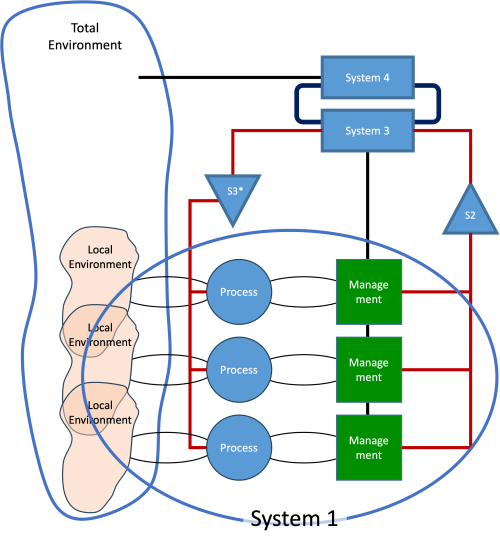
While Systems 2 and 3 work the inside — stabilizing and optimizing what already runs — System 4 brings in the outside view and the forward plan. And it does not work alone; it takes a constant feed from System 3, so its picture of the future is grounded in the state of the present.
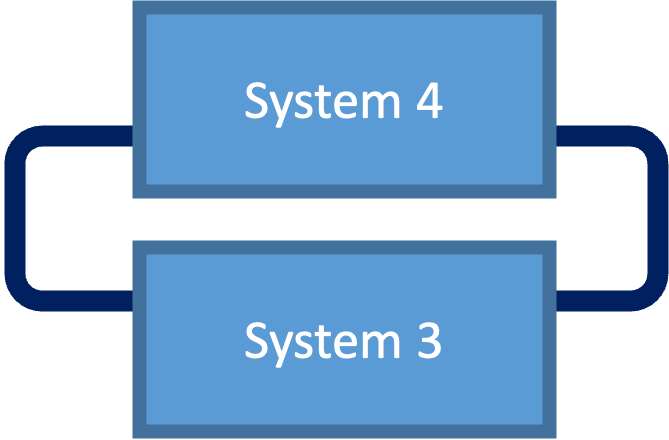
Put it in the body, walking through a jungle toward a destination. System 4 takes in the outside world and sets the route. System 3, meanwhile, is reporting from inside: there’s a minor injury in one leg, so we cannot push the pace. Holding both, System 4 realizes the destination is out of reach before dark — and changes the plan to find a place to rest instead.
Handed that new plan, System 3 retunes the body for an efficient pace and assigns the eyes a fresh task: scan for a good spot to stop. The eyes now serve two jobs at once. And it is the coordination between Systems 2 and 3 that lets them search for shelter while still guiding the body around rocks, puddles, and trees — two goals that could have fought each other, held in balance instead.
System 5 — policy and identity
Imagine the body run as a pure central command, every organ idling until headquarters issues an order. By the law of requisite variety, we already know this is impossible: no central command could ever hold the variety of all its organs, let alone the vast world they live in. The brain would have to remember to tell the lungs to breathe while telling the heart to beat while directing the white blood cells against an intruder. It cannot be done.
Now imagine the opposite — total decentralization, every organ fully autonomous, free to chase whatever its immediate state demands. That ends just as badly. One organ senses thirst and turns the body toward water while another, sensing danger, hauls it the other way, and a third, in the middle of all this, simply wants to sleep. The eyes insist on watching the sky while the legs run, and the hands decide to grab the nearest branch and never let go. A riot of local optimization, tearing the system apart.
The living body does neither. It is tuned so finely that there is almost no argument between what the future needs and what the moment demands. Thousands of tasks run at once, the body stays aware of its surroundings, its threats, its openings, and it plans accordingly.
Striking that balance between Future and Now — between System 4 and System 3 — is what keeps a system viable. The function that holds it is System 5.
System 5 watches the balance between Systems 3 and 4 and guards the long-term viability of the whole: its identity. It is the part that makes sure every other activity and decision still points the same way — toward the organization’s direction, its values, its purpose. It is, in the end, the answer to the question who are we — and the keeper of that answer when the pull of the present and the pull of the future try to drag the system in two.
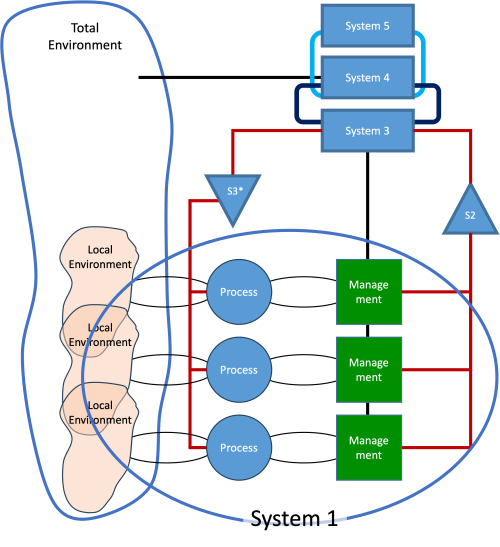
We now have all five systems, and a complete viable organization on the page. But the model has one more move in it — and it is the most elegant of all. In Part 5: recursion.