Viable System
The Viable System Model – Part 2
Give every department the autonomy it needs and they'll each optimize themselves straight into each other. Part 2: System 2, the quiet coordinating function that keeps the parts from colliding — without becoming the bureaucracy that smothers them.
Science has sought the ultimate source of energy in the physics of the sun itself … the hydrogen-helium fusion. Science now seeks the ultimate source of control, in the cybernetics of natural processes … the brain itself.
Cybernetics and Management, Stafford Beer, 1959
System 2 — keeping the parts from colliding
As an organization grows, it sprouts more processes, and each new process needs its own management to run it well.
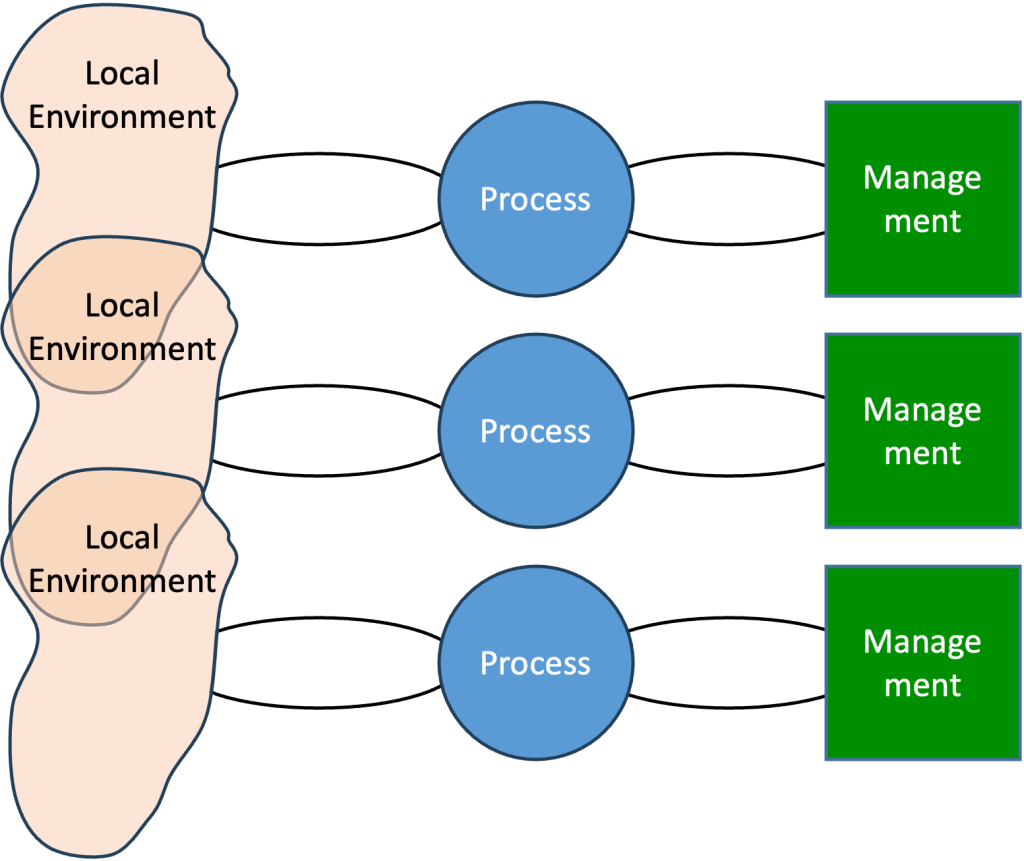
If an organization built this way can hold an identity and keep existing on its own, we can call it a Viable System.
Viable system
A system capable of independent existence.Stafford Beer
A small caveat, because Beer would insist on it: nothing alive is absolutely independent. No organism is. So read “independent” with some leniency — it is a subtle idea, not an absolute one.
Here is the trouble that growth creates. Each line of management is busy mastering the variety of its own process, and nothing, so far, guarantees that what one of them does makes any sense alongside what another is doing.
Picture it concretely. The finance manager chases efficiency and drives inventory toward zero. Clean books, admirable. But now the sales manager cannot say yes to a customer who wants the product today, because there is nothing on the shelf to ship. One manager hit their target by making the other’s target impossible. Each was rational. Together they oscillate, the system swinging between empty shelves and overstuffed warehouses, and never settling.
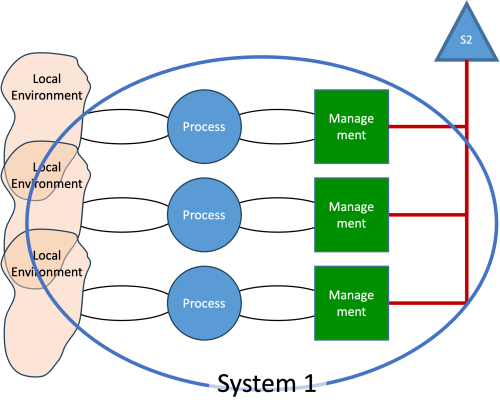
If those separate lines of management are going to behave like one organization, something has to manage the variety between them — the vertical variety, not just the horizontal. Call it System 2.
But notice the bind we have just walked into. Those horizontal managers need their autonomy; it is the only way they can muster enough requisite variety to handle their own complex processes. And the moment System 2 starts making rules to hold the whole thing together, every rule draws a line — a set of do’s and don’ts — that eats into exactly the autonomy those managers depend on. We need them maximally free to deal with their own variety, and we have just made them less free.
Important
So an organization has to stay alert to the cost of over-attenuating variety on this vertical axis.
Cut their variety too much and the horizontal managers can no longer run their own processes. Cut it too little and the whole organization loses its coherence and flies apart. System 2 lives on that knife’s edge.
The way through is to understand what System 2 is for. It provides a service — it ensures cohesion, keeps activities aligned, and damps the oscillation. It is not there to rule.
Ensure cohesion
The delicate point: System 2 exists to ensure cohesion, not to “control.” The day it starts trying to control is the day it begins turning into a bureaucracy.
That is the whole job. System 2 coordinates the activities of System 1, settles the conflicts between System 1’s elements, and carries the decisions about shared resources, services, and information. A coordinating service, not a throne. Keep that distinction — in Part 3, the temptation to forget it returns with teeth.