Viable System
From a Reductionist Approach to a Holistic One
We were taught to understand the world by cutting it into smaller and smaller pieces. It made us powerful — and it left us unable to see the one thing that matters most in any organization: the relationships between the parts.
Aristotle’s principle of non-contradiction says a thing cannot be “A” and “Not A” at the same time. From that single rule, a whole way of seeing the world unfolds. If everything is either A or Not A, then anything can be split — A into B and Not B, B into C and Not C — on and on, the world dividing cleanly all the way down.


And the deeper you travel down any one branch, the further you drift from all the others. For centuries, physicists had almost no idea what was happening in chemistry; mathematicians knew little of what biologists were up to. Each branch went down into its own dark, and the branches stopped being able to see each other.
This habit runs deep. It is how we see the world, and so it is how we build things. Our entire approach to management and understanding is reductionist at its root. We take a company and carve it into departments — finance, HR, casting, machining, sales, procurement — and the carving gives us a comforting sense that we have understood the complex thing. But Stafford Beer asks the question that punctures the comfort:
Does God know the difference between Physics and Biology?!
Stafford Beer
Is there something in the spaces between our categories that we have not named yet? Some dark places our torch has not reached?
For a long time, electronics and mechanics were separate disciplines. Now we have electro-mechanics, bio-mechanics, biochemistry, a whole shelf of hyphenated fields. But notice why they appeared: not because anyone decided the universe was whole and ought to be seen whole, but because two separate branches happened to grow far enough to touch. We did not abandon the silos. We just built more silos in the gaps between them.
The holistic alternative
So here is the question worth sitting with. Instead of breaking everything into separate components and studying each alone, why not step back and look at the whole system?
The term system is unquestionably one of the most widely used terms not only in science, but in other areas of human endeavour as well. It is a highly overworked term, which enjoys different meanings under different circumstances and for different people. However, when separated from its specific connotations and uses, the term system is almost never explicitly defined.
Facets of Systems Science, George Klir
George Klir points out that we almost never say “system” on its own. It always arrives with a companion that pins it down: physical system, political system, computer system. And in Facets of Systems Science, he offers a clarifying example. A pile of books in one place is not a system. It becomes part of a system only when the books are ordered — when relationships are imposed on them. The books are not the system. The order is.
Watch enough kinds of systems and the same underlying truth surfaces in all of them: every system, of any kind, is a collection of things plus a set of relationships between those things. And once you hold that, your attention shifts. You stop staring at the things and start seeing the network of relationships — which is where a system actually lives.
That shift is deeply non-reductionist. It is holistic, and it is much older than our science. You can find it running through Eastern philosophy.
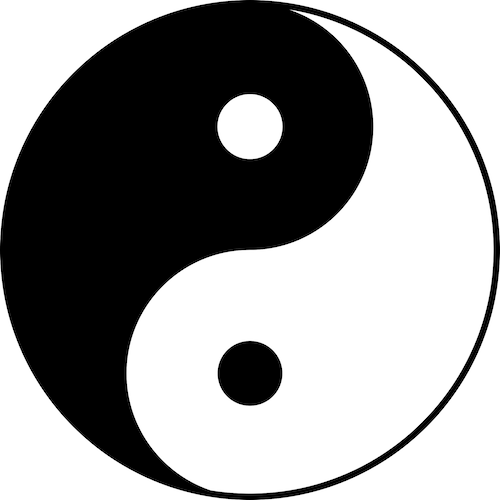
In the Taoist yin-yang, everything carries some of its opposite within it — and even at its fullest, a small seed of the other remains. High and low present at once. A and Not A, coexisting. The very thing Aristotle’s logic forbids.
We should take on-board eastern thinking as well as western thinking. Because, I think, they understood a lot of this [the holistic view of the universe] from way back; and we have adopted a different model, which has made us far more successful in terms of beating nature and getting rich in various ways, but has left us philosophically, ethically, and emotionally drained.
Stafford Beer
The reductionist approach has paid for itself many times over; none of this is to throw it away. But it carries a hidden cost, and the cost is this: using a model traps you inside that model.
Take a company already divided into departments. Any plan it makes for its own future is forced to speak in the language of those same departments — the same divisions, the same boxes. The model that helped you understand the present quietly fences in what you can imagine for the future.
And that, all by itself, holds change back.
When the change finally comes, a reductionist organization can barely adapt in time. Its only real move is to retrain and reorganize — to swap one reductionist model for a slightly different one, and call that progress.
We trained hard — but it seemed that every time we were beginning to form up into teams we were reorganized. I was to learn later in life that we tend to meet any new situation by reorganizing, and what a wonderful method it can be for creating the illusion of progress while actually producing confusion, inefficiency, and demoralization.
Petronius, 210 BC
What we need instead is a model of organizations that can actually move with the changes around it. That is precisely what Stafford Beer built with the Viable System Model: he studied the organization of the most complex and viable system we know — the human being — and drew from it a way to organize and manage our own affairs so that they, too, can stay viable.