Cybernetics
The Cybernetics of Having a Thick Skin!
Same sentence, same room — and it rolls off one person while it lodges in another for three days. That gap is not character. It's cybernetics. Here's why the same information becomes a conflict for one person and noise for another.
A manager says, in a Tuesday planning meeting, “I’m not sure this plan holds up.” Two people hear the exact same sentence. One of them nods, files it as a fair question, and forgets it by lunch. The other carries it home, replays it on the drive, rehearses three things she should have said, and is still turning it over on Thursday.
Same words. Same room. Same tone. One person barely registers it; the other is wounded by it. We usually explain this away with character — she’s sensitive, he’s got a thick skin — and then we stop thinking, as if we’d explained something. We haven’t. We’ve just named it.
What actually happened is cybernetic, and it is worth slowing down for, because it sits underneath every dispute you will ever try to resolve.
Human beings are survival machines. By design, we work to reduce our discomfort. Hungry, we look for food. Exposed, we look for shelter. So when something lands as discomforting, the body does not sit still — it moves to close the gap. As Kenneth Cloke puts it, conflicts are “immense sources of stress and pain, which we try to avoid.”
But notice what has to be true before there is anything to avoid. A conflict requires two things, in order: first, you perceive a difference between what is and what you believe ought to be; and second, you evaluate that difference as discomforting — as a deviation from where you want to rest.

Every one of us carries a set of parameters — beliefs, values, things we expect of the world — that together define our equilibrium, our steady state. We are constantly taking in information and quietly comparing it against that set. Most of what we perceive registers as different from the ideal without ever raising an alarm, because we don’t read it as a deviation worth correcting. The difference is there. The discomfort is not. No conflict.
The alarm only sounds at the second step. The moment a difference gets evaluated as a deviation, conflict has occurred — and so have the uncomfortable feelings that come with it. Those feelings are not the problem. They are the control system doing its job, pushing you back toward equilibrium. This is also why, as Cloke notes, it is so easy for people to “cast themselves as innocent victims acting on principle.” Of course they do. They perceived a deviation from what they hold as right, and they acted to correct it. From the inside, that always feels like principle.
Which brings us back to the meeting. The reason the same sentence wounds one person and not the other is not that one is brave and one is fragile. It is that the sentence crossed one person’s threshold of evaluation and not the other’s. For her, “I’m not sure this plan holds up” registered as a deviation that had to be corrected. For him, it registered as merely different — tolerable, no movement required. That difference in tolerance is what we colloquially call thin-skinned versus thick-skinned. It is not a moral grade. It is a property of two complex systems with two different thresholds.
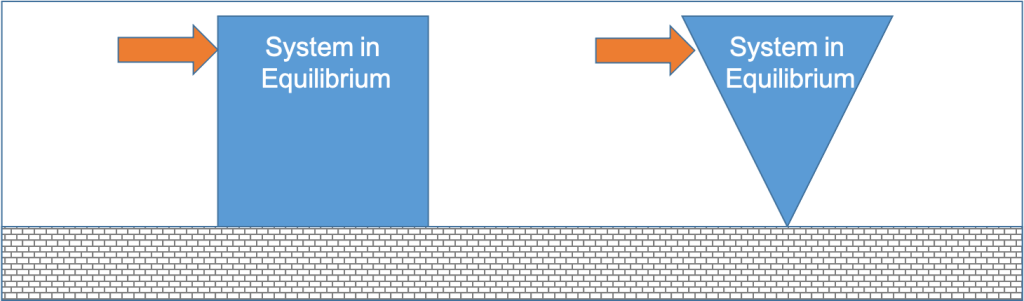
Now scale it up. Ashby gives us the rule for what equilibrium means in a system of many parts: “the whole is at a state of equilibrium if and only if each part is at a state of equilibrium in the conditions provided by the other parts.” Read that slowly, because it has a hard edge. It means a single person pushed out of their steady state is enough to put the whole out of its. One wounded member, and the system — the team, the family, the firm — is no longer at rest, whether or not anyone has said a word yet.
So a social system in equilibrium turns out to be a precise thing: a group of interacting people with no conflict between them. Not no differences. No deviations. A state of no conflict.
That state is rarer, and more fragile, than we like to believe. What happens when it breaks — when the wounded person finally moves — is where this goes next.
References
[1] Cloke, K. (2001). Mediating Dangerously: The Frontiers of Conflict Resolution [Kindle Version]. San Francisco: Jossey-Bass.
[2] Emotion, as defined by the American Psychological Association (APA): “a complex reaction pattern, involving experiential, behavioral, and physiological elements, by which an individual attempts to deal with a personally significant matter or event.”
[3] Ashby, W. R. (1956). An Introduction to Cybernetics (Vol. 37). London: Chapman & Hall.