Cybernetics
Basic Notions – Cybernetics
The word comes from the Greek for 'helmsman' — the one who fixes their eyes on a destination and corrects, and corrects, and corrects again against the wind and the waves until they arrive. That image is the whole science: control and communication, in the animal and the machine.
Picture a helmsman steering a boat. Eyes fixed on a destination, fighting the wind and the waves, they never hold the wheel still — they correct, and correct again, course-correcting continuously until they arrive. That image is buried in the word itself. Norbert Wiener coined cybernetics from the Greek κυβερνητική (kybernētikḗ), by way of the Latin gubernātor — helmsman, steersman, pilot. And it is exactly what the field is about: “the science of control and communication in the animal and the machine,” as Wiener wrote in the first book on the subject in 1948.
The idea was born a few years earlier, in 1943. Working on wartime problems, a group of authorities from wildly different fields — Wiener in mathematics, Arturo Rosenblueth and Warren McCulloch in neurophysiology, Margaret Mead and Gregory Bateson in anthropology, W. Ross Ashby in psychiatry, and others — came together, and out of their cross-disciplinary arguments emerged a single shared idea: control as a concept common to every branch of human knowledge. That was the seed of cybernetics.
This is what makes cybernetics holistic. It speaks to physical, biological, political, technological, chemical, psychological, and social systems alike, because every one of them has control running through it — which makes cybernetics about the most comprehensive language we have for describing complex systems. It also ties directly to ideas like intelligence, success, and survival, each of which depends on the same thing: constant course-correction toward a target.
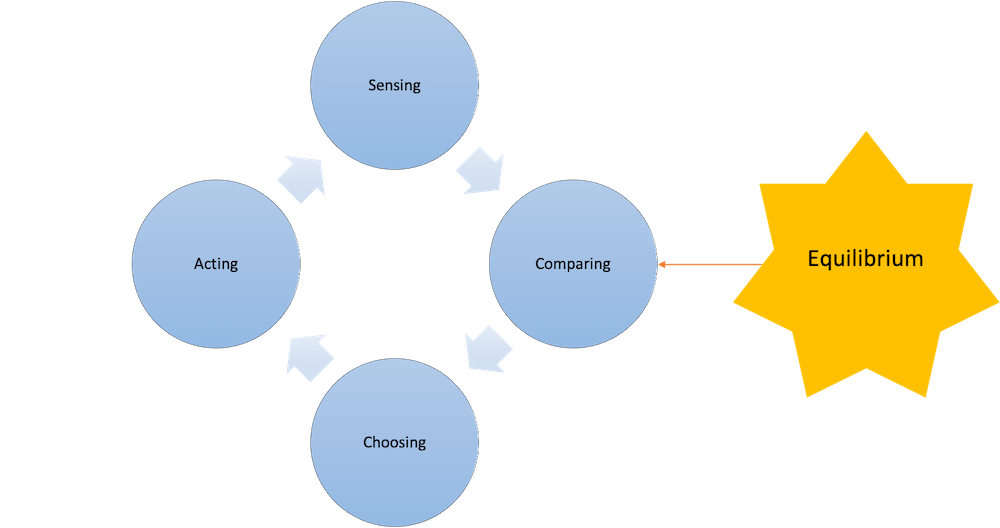
Every intelligent system has this built in. One way or another, it is always adjusting its parameters to hold a target — whether that’s a predator steering after running prey across rough ground, the body holding its blood-sugar level, or a hand guiding a pen across a page. All of it runs on constant, concurrent loops of sensing, comparing, choosing, and acting. Self-correction, without pause.
References
[1] Wiener, N. (1948). Cybernetics: Or Control and Communication in the Animal and the Machine. Cambridge, MA: The MIT Press.
[2] This group later formed the Macy Conferences, chaired by McCulloch, to promote meaningful communication across scientific disciplines. (Summary: The Macy Conferences, 2021.)