Cybernetics
Basic Notions – Disturbance or Perturbation
Add one force the others can't cancel — a toxic boss, a betrayal — and a balanced system tips out of equilibrium. What it does next is the whole story: it goes hunting for something to restore the balance. And not every counterweight it finds is a healthy one.
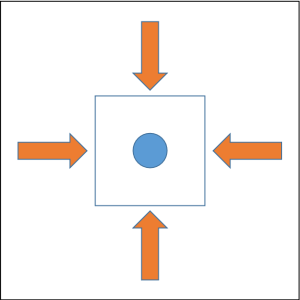
Take the balanced person from before, forces all canceling out, and add one more force the others can’t absorb — a toxic workplace, say, or being bullied by a colleague. Now the sum is no longer zero. The person can’t hold their old equilibrium, and they lose their balance. The situation is, quite literally, out of control and out of equilibrium.
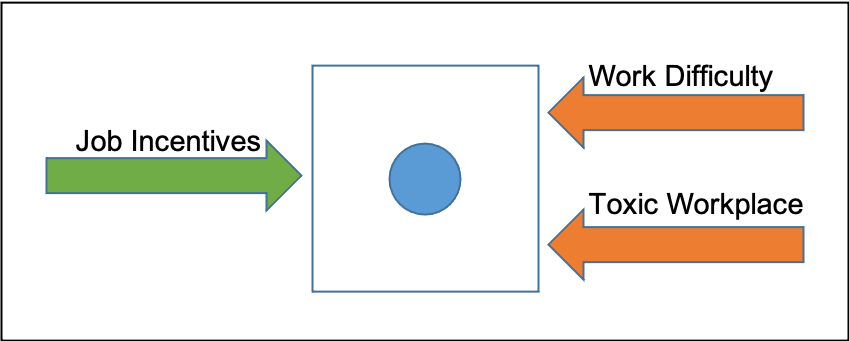
That is a disturbance. When the forces on a stable system stop canceling out, they push it out of its equilibrium — another reading of Newton’s first law. Ashby defines disturbance plainly: “simply that which displaces, that which moves a system from one state to another.”
And from everything we know about control, we can predict what happens next. The displaced system goes looking for a new equilibrium; the person’s control functions drive them to find something that can balance the forces now pressing on them. They will reach for a counterweight wherever they can find one — a supportive family, venting to friends, the promotion on the horizon, or, on the other side of the ledger, quietly dialing down their performance, or drink, or drugs. The system does not much care whether the counterweight is healthy. It only wants to be balanced again.
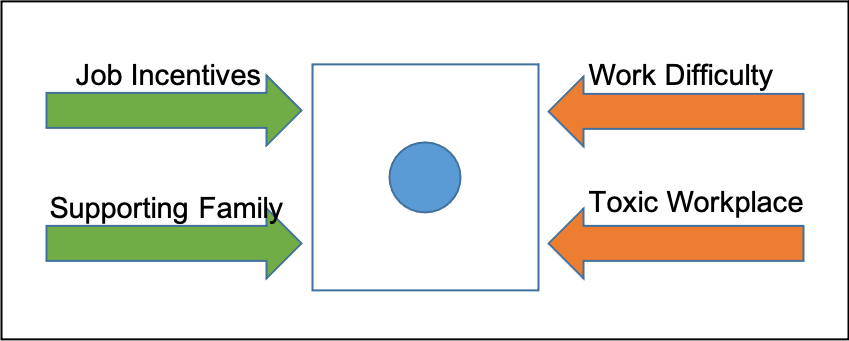
Add a healthy counterforce — a loving, supportive family, say — and the forces cancel once more. The person settles into a new equilibrium and is stable again.
These diagrams are, of course, vastly oversimplified, drawn only to show the basic notions — equilibrium, control, disturbance, and the forces acting on a person in their environment. Real life is far more tangled and far less visible. Anyone living and working in a large city absorbs a constant stream of perturbations of every size and shape: a colleague’s mood, a boss’s attitude, the difficulty of the work, competition, traffic, the air itself.
References
[1] Ashby, W. R. (1956). An Introduction to Cybernetics (Vol. 37). London: Chapman & Hall.
[2] These are effective tools for numbing the pain and dulling the control function. A person out of equilibrium feels the pull to balance the forces on them, and grows more uncomfortable until they can. Besides finding a real counterforce, the other way to quiet that urge is to numb the discomfort itself — which erases the question rather than answering it.