Cybernetics
Basic Notions – Feedback Loops
Sense, compare, choose, act — then sense again. That four-beat loop is the smallest unit of control there is, the thing running underneath a thermostat, a body, and a business alike. Here's how it works, and why nothing stays on target without it.
For any control to happen at all, a system needs four things working in sequence. A sensor to detect and feed in information, from the environment or from itself. Some logic to process that information, compare it against a set of parameters — goals, targets — and register the deviation. A decision mechanism to choose, among the options, how to correct that deviation. And finally, acting parts that carry out the choice and change the state of the system.
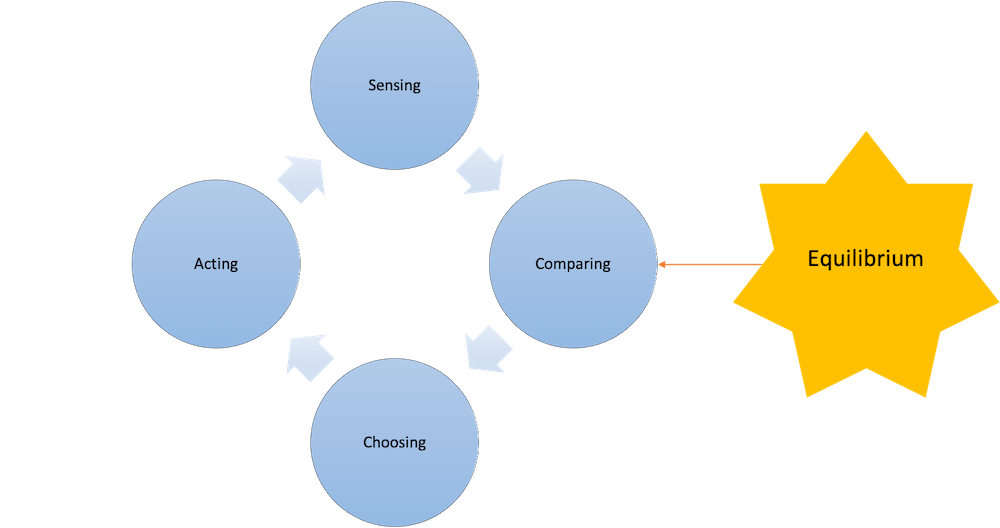
The movement of information through those four — from sensing to comparing to choosing to acting, and then back to sensing — is what we call a cybernetic feedback loop. Each part takes an input from the one before it and hands an output to the one after, and the whole thing closes on itself: the result of acting feeds back in as something new to sense. A loop.
Feedback loops are the building blocks of every control system. They are what let a system measure itself against its target, find a way to close the gap, act, and then check whether the action actually worked — sensing the new deviation, correcting again, and again, until the target is reached. Sense, compare, choose, act, repeat. It is the smallest unit of staying on course there is.
References
[1] Beer, S. (1959). Cybernetics and Management (p. 9).
[2] Beer, S. (1974). Designing Freedom (p. 50).