Cybernetics
Basic Notions – Equilibrium
An object holds still not because nothing is pushing on it, but because everything pushing on it cancels out. People work the same way. The employee who stays in a hard job isn't unbothered — they're balanced. Understand the balance and you understand why things hold.
Newton’s first law tells us that “an object at rest will stay at rest, and an object in motion will stay in motion unless acted on by a net external force.” So as long as the forces on an object cancel each other out, it holds its state and nothing changes. The same is true of any system. As W. Ross Ashby puts it, “all machines started in a basin will come to a state of equilibrium, if one exists.” Which gives us a clean definition: equilibrium is the state of a system in which all the forces imposed on it sum to nothing.
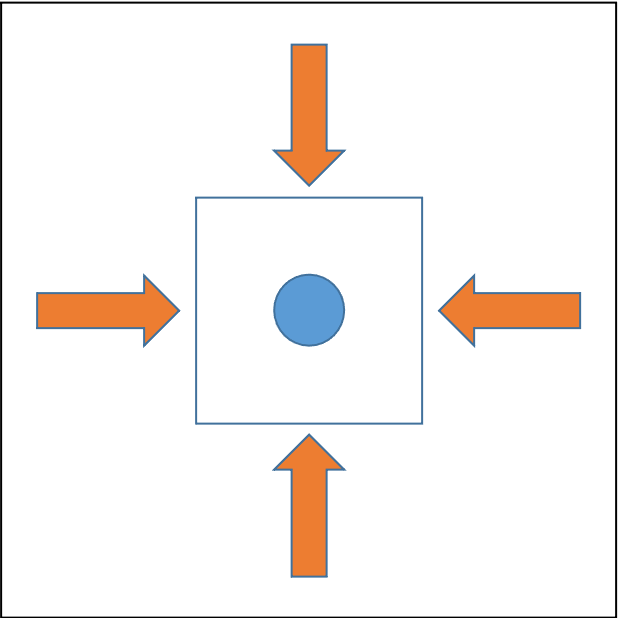
Carry that into human terms and the object above becomes a person at rest. Forces are pressing on them from every side — but because the forces counteract each other, the person stays where they are. Equilibrium is not the absence of pressure. It is the balance of it.
Take an employee in a demanding job, grinding through hard work day after day. As long as the incentives feel fair for the effort, the two opposing forces — the difficulty and the reward — cancel out. The balance holds, and the employee stays. Change either side of that equation, and the stillness ends.
References
[1] Ashby, W. R. (1956). An Introduction to Cybernetics (Vol. 37). London: Chapman & Hall.