Dispute Resolution
From Conflict to Dispute
We use 'conflict' and 'dispute' as if they were the same word. They are not — and the difference matters. One is something you feel alone, inside. The other is what happens when you act on it. The etymology tells the whole story.
We tend to use conflict and dispute interchangeably, but they are not the same thing — and the modern media hasn’t helped. By stretching “conflict” across armed conflict, deadly conflict, countries in conflict, we have dramatized the word past its real meaning, while “dispute” has drifted toward the quieter, more legal end of disagreement. To see what each actually means, it helps to go back to where the words came from.
Dispute comes from the Old French disputer — to argue or discuss — and before that the Latin disputare, to debate or explain. Take it apart and you get dis- (apart) plus putare (to count, to consider).
Conflict comes from the Latin con- (together) plus fligere (to contend) — to be in opposition, contrary, at variance. In ancient Greek literature, conflict is the agon, the challenge the protagonist faces in its many forms of uncertainty.
Notice what the roots reveal. Conflict has a sense of being, and a strange two-way focus on togetherness — it names an inner feeling that something is different from what one wants or expects, and that the difference is discomforting. A discomforting difference. Dispute, by contrast, is active: it is about engagement, about being apart and set against another.
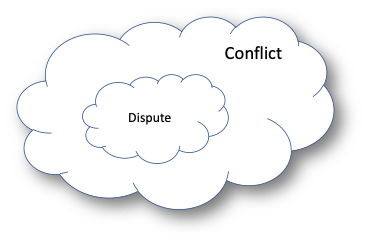
Which means conflict is the larger territory, and dispute is a region inside it.

Any discomforting difference creates a conflict inside an individual. A dispute only emerges between people — when someone acts on their conflict by engaging another person to address the discomfort it has caused them. A conflict may grow into a dispute. It may also turn into many other things instead — withdrawal, say, or depression. But a dispute always traces back to a conflict underneath. There is no dispute without a conflict at its root.
References
[1] Marchant, J., & Charles, J. (1977). Cassell’s Latin Dictionary. London: Cassell.
[2] Note that fligere with the prefix con- takes the meaning of “contend.” Without the prefix, fligere sits closer to fligo — strike, clash.