Organizational Design
Design a Conflict-Wise Organization
Most organizations wait for conflict to harden into a dispute, then scramble to contain it. A conflict-wise organization does the opposite — it goes looking for conflict early, on purpose, because that's where the synergy is hiding. Here's how one is designed.
A disagreement starts small — a warehouse manager and a sales manager who simply want different things. By the time it reaches anyone whose job it is to deal with it, it has stopped being a disagreement and become a dispute, with sides, and history, and a temperature. The organization reacts. It contains the damage. And it never asks why it was the last to know.
That lag is the real problem, and it points at a better set of questions. What does success even look like in a conflict situation? How would you measure it? And how would you design an organization so that it gets there on purpose, rather than by luck?
Chase those questions and you will run into William Ury’s Getting Disputes Resolved: Designing Systems to Cut the Costs of Conflict. Ury names four measures of success:
- Minimizing transaction costs
- Satisfaction with the outcomes
- The effect on relationships
- Recurrence
You could fold “effect on relationships” into transaction costs, but keeping the four distinct is useful — it lets a practitioner define what success means for their particular situation and design a dispute system to actually reach it. Such a system can lay out specific steps, dynamics, and flows of information so people can manage their conflicts, on their own or through a third party — a mediator, an arbitrator, a judge.
And the field has not stood still. Lynch points out that you can design for conflict not just case by case, but as “a comprehensive, systems approach to the prevention, management, and resolution of conflict.”
Which raises the question I keep circling back to. Why wait for the dispute at all? Should an organization really sit still until conflict erupts and then react — or is there a way to get ahead of it?
Because conflict does not wait. It grows, and as it grows it stirs emotion at a compounding rate, until it finally surfaces as a dispute between people. Every day an organization takes to detect, react, and manage that dispute is another day for a toxic workplace to set in — for dysfunctional decisions and destructive behavior to become normal.
What a conflict-wise organization actually is
An organization is a complex system of machines, processes, and people. And since conflict is a discomforting difference, the math is unforgiving: as long as there are differences — in approach, in objective, in responsibility — there will be conflict, because some of those differences will land as discomforting to someone. The warehouse manager pushing inventory toward zero is, from the sales manager’s chair, making it impossible to say yes to customers. Neither is wrong. They simply want different things, and the difference stings.
So at any moment an organization is carrying many conflicts. Some have already grown into disputes. Many have been “resolved” only in the sense that one party gave up, or left. A conflict-wise organization is not the one with the best dispute process. It is the one equipped — in its skills and its instincts — to notice conflict early and manage it well, on purpose and without flinching.
That capacity pays for itself across everything organizations usually treat as separate line items: morale, productivity, turnover, hiring, retraining, absenteeism, waste, litigation, the slow erosion of reputation. Managing conflict early is how you protect all of them at once — and more than protect. Handled well, conflict is where harmony, creativity, and mutual growth actually come from.
One thing it is not: a new box on the org chart. Being conflict-wise does not mean handing conflict management to legal or to HR. It means a culture that is conflict-wise everywhere — the wisdom internalized in every employee, at every level.
How a conflict-wise organization is designed
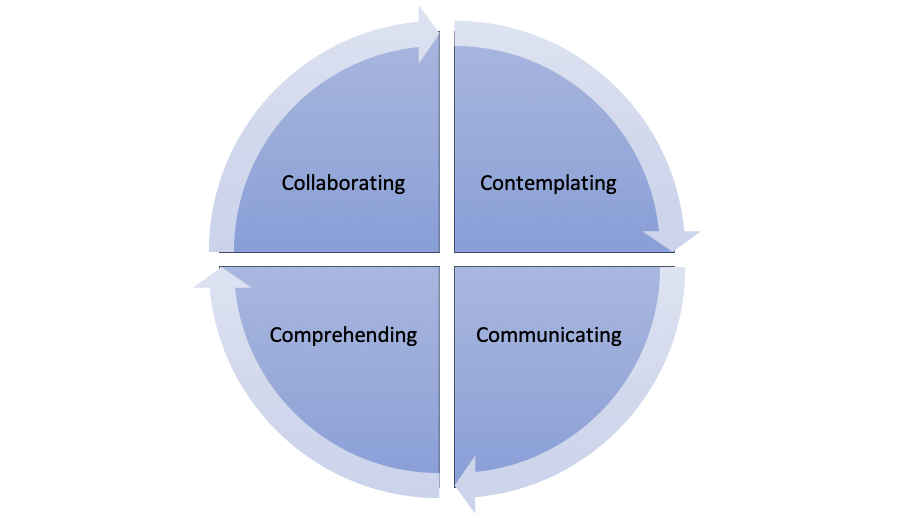
It starts, oddly, on the inside. To understand conflict between people, you begin with contemplation — self-awareness. We are practiced at watching the world out there and unpracticed at looking in. But understanding your own needs, beliefs, values, and thoughts is the foundation for genuine two-way communication, the kind where self-aware people can say clearly what they think and need, ask real questions, and get real answers.
That exchange makes comprehension possible — actually grasping what the other person needs, learning from them, making sense of choices and beliefs that aren’t your own. And once that mutual understanding of values exists, people can finally collaborate: engage, build, create synergy. Contemplate, communicate, comprehend, collaborate. Each one depends on the one before it.
Why so few organizations get there
Organizations live or die on people collaborating well, and very few have truly managed it. Real collaboration requires proactive conflict management — and most organizations quietly decide they can skip that part and press on.
The brutal pace of competition is part of why. Leadership teams find it hard to spend time on something as slow and laborious as contemplating, communicating, comprehending, and collaborating. It costs time and energy, the two scarcest resources there are. And for decades, organizational design has chased the most efficient possible structure — the organization as a machine that minimizes waste — a frame in which conversation and dialogue look like exactly the kind of waste to cut.
So it follows that conflict wisdom cannot be installed from the middle. It cascades from the top. An organization becomes conflict-wise only after its leadership does.
How it handles conflict, day to day
In a conflict-wise organization, people are good at finding conflict — naming it rather than hiding or avoiding it — and the organization backs them with the support to manage it constructively.
It provides a safe enough environment that people will actually voice concerns and give honest feedback. Managers and employees talk constantly — frequent conversations, the thing we used to call “meetings” — to share ideas, ask questions, and learn from one another. For any given situation, the team designs the solution together and executes it together, watching for and clearing away the barriers to participation, welcoming difference instead of smoothing it over.
In that environment, conflicts get caught early and worked through the four Cs before they harden. Few ever grow into disputes, which lowers the collective stress of the whole organization, and with it the cost. Conflict management is not centralized anywhere; it is simply what everyone does. It becomes the new normal — until having a hard conversation about a real difference is no longer a burden people dodge, but something they actively go looking for, because they have learned that it is where the next bit of synergy is hiding.
Works Cited
[1] Ury, W., Brett, J., & Goldberg, S. (1988). Getting Disputes Resolved: Designing Systems to Cut the Costs of Conflict. San Francisco: Jossey-Bass.
[2] Lynch, J. F. (2001, July). Beyond ADR: A Systems Approach to Conflict Management. Negotiation Journal, 17(3), 206–216.
[3] Dues, M. (2010). The Art of Conflict Management – Achieving Solutions for Life, Work, and Beyond. Chantilly, VA: Teaching Co.